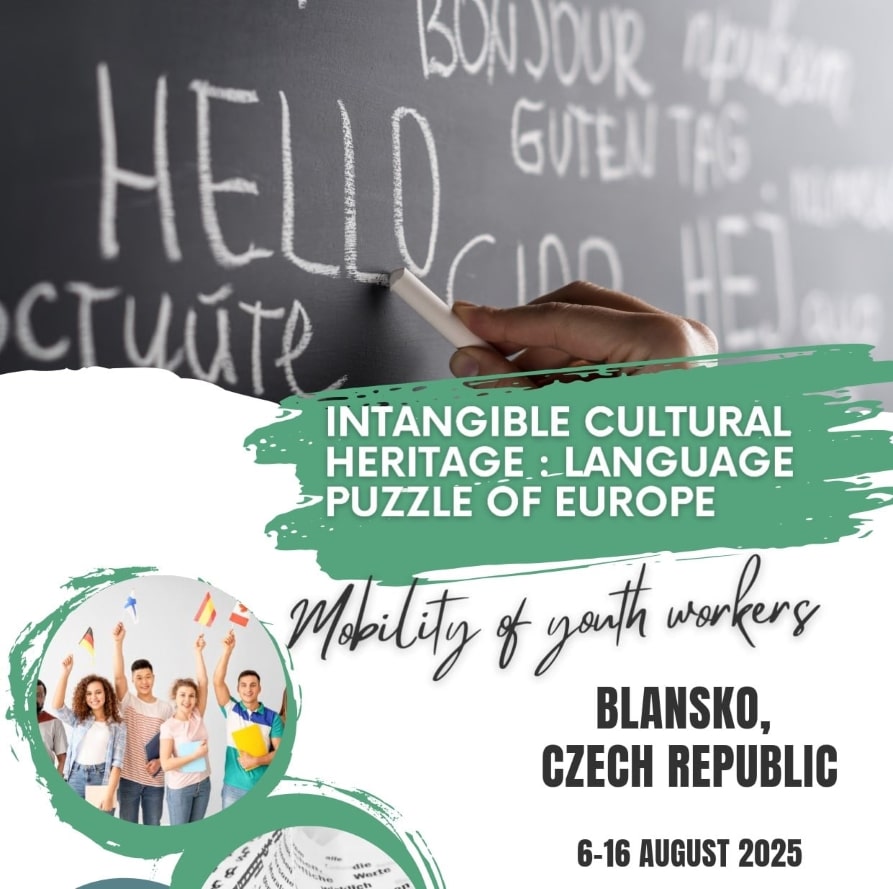
The Erasmus+ project “Intangible Cultural Heritage: Language Puzzle of Europe” will bring together 33 youth workers from Czech Republic, Italy, Spain, Romania, France, Turkey, North Macedonia, Portugal, Malta and Poland. Each country will be represented by 3 participants.
Cultural heritage education plays an important role in shaping the identities, values, and perspectives of young people, serving as a foundational element in fostering a deeper understanding and appreciation of the diverse world we live in. We believe that language might play an integral role as a key tool in understanding, teaching about, and appreciating diverse cultures and heritage. It helps young people understand and take pride in their own cultural backgrounds while respecting and valuing the diversity of others. It can also strengthen bonds within and between communities, fostering social cohesion, encouraging active citizenship and community engagement by highlighting the importance of preserving and contributing to one’s cultural legacy. It encourages young people to think critically about history, culture, and identity. It invites them to consider multiple perspectives and the dynamic nature of cultures, fostering a nuanced understanding of global issues and historical events.
Aim and objectives:
- Provide tools and methods for youth workers to create and sustain collaborative learning communities that promote cross-cultural understanding and shared cultural experiences.
- Enable youth workers to understand and demonstrate how language is intertwined with cultural heritage.
- Equip participants with digital skills to incorporate technology and media into language-based cultural activities.
- To integrate blended methodologies, incorporating ict, digital tools, arts, and outdoor spaces, to enhance youth workers’ digital competencies, media literacy, and creative teaching approaches.
- To equip youth workers with the skills to utilize stop motion animation as an innovative tool for engaging young people in exploring and understanding the complex relationship between language and cultural heritage.
Output:
A toolkit that compile the methods and tools explored during the course (such as language games, storytelling exercises, and stop motion workflows) making them accessible to youth workers across Europe.